Sunday, March 29, 2009

the Gazala Battle turns against the British on 5 June 1942

Initially, the battle on 5 June 1942 favoured the British. Early in the morning, the battle turned and the Germans, particularly, had the advantage. The initial British thrust in the early morning dark succeeded only because the attacking forces stopped short of the main Axis force. The 22nd Armoured Brigade had a strength, before the fight, of 156 tanks. They were a mixture of Grants, Stuarts, and Crusaders. They quickly ran into heavy artillery fire and turned north. They left the infantry unsupported when they were struck by German tanks. The 2nd Highland Light Infantry were driven backwards onto the Gurkhas. The same sort of thing happened to the 2nd West Yorkshires. The British fought dispersed, without support and could be beaten in detail. The 32nd Army Tank Brigade had started their attack on the Sidra ridge with 70 infantry tanks and lost 50 before the attack was canceled. This is based on the account in Vol.III of the Official History.

Monday, March 23, 2009

The flawed command structure

The planned attack on the Cauldron was to be mounted with no single officer in command. Instead, there were these independent units involved, but operating on their own. The plan sounds like another typical 8th Army operations, with the forces sent off in all directions, acting alone. The 10th Indian Brigade would attack to the west. The 32nd Army Tank Brigade would attack south and take the Sidra Ridge. Following those movements, timed to happen sequentially, the 7th Armoured Division and 9th Indian Brigade would attack west into the Cauldron. Why could they have not been more concentrated and moved together? This was all to commence on 5 June 1942. This is based on the account in Vol.III of the Official History.

Saturday, March 21, 2009

Auchinleck's plan

By 2 June 1942, General Auchinleck wanted to mount an attack towards Bir el Temrad from the XIII Corps front. He was the only one in favor of such a move, as it was opposed by General Ritchie and his corps commanders. He had also thought about a turning movement around the southern end of the front, but gave it up in face of opposition and the questions about their ability to keep the attack supplied. He then decided that they would attack the Axis forces in the vicinity of "The Cauldron". The attack would be mounted on 5 June and would start with the 10th Indian Brigade and the with 4th RTR support easily took their objective. The other moves also went well, but that was because the Axis forces were further to the west than the plan had foreseen. The result was that the result was very bad. This is based on the account in Vol.III of the Official History.

Thursday, March 19, 2009

Other moves on 2 June 1942

Rommel tried to distract the British from Bir Hacheim by sending the 21st Panzer Division on a feint towards Eluet et Tamar on 2 June 1942. They encountered the 5th RTR and destroyed 12 of their tanks. The 5th RTR was one of the regiments in the 4th Armoured Brigade. That was the only major movement for a few days while both sides were working on recovering and repairing tanks and reorganizing for the next phase of the battle. The DAK had been reduced to just 130 runners from the total of about 320 tanks that they had at the start of the battle. This is based on the account in Vol.III of the Official History.

Friday, March 13, 2009

The fight for Bir Hacheim, starting 2 June 1942

The Germans and Italian forces moved on Bir Hacheim next. 2 June 1942 was a day of sand storms. On 3 June, the German air force started bombing Bir Hacheim. For their part, the RAF hit the easy targets presented by the concentrated German and Italian units moving on Bir Hacheim. The RAF shot down 16 German and Italian aircraft at the cost of 13 lost. The Free French forces were heartened by the strong air support.


British and Commonwealth ground forces were active, but mostly with Jock columns operating on the German supply lines that cut through the minefields at Trigh Capuzzo and the Trigh el Abd. Columns were drawn from the 1st South African Division, the 50th Division, and the 7th Motor Brigade. The one brigade-size attack was made by the 1st South African Brigade against the Trento Division. This is based on the account in Vol.III of the Official History.

Friday, March 06, 2009

Bir Hacheim


Rommel was in a somewhat more secure position by 2 June 1942. After taking the Sidi Muftah area, he intended to attack Bir Hacheim with some of his better infantry: the 90th Light Division and the Italian Trieste Division (motorized). The Official History notes that by this phase of the battle, Rommel had lost General Gause and Colonel Westphal to wounds.


Since 30 May, the British had been very active in the air, but by 2 June, they had taken many losses and had to stop low level attacks on Axis ground forces due to the dwindling stocks of Kittyhawks. The British had lost 50 aircraft in the first 5 days of the battle. The only good sign was the arrival of the first Spitfires in the fighter role. The plan was to use them to fly high cover for Hurricanes used as fighter-bombers. This is based on the account in Vol.III of the Official History.

Sunday, March 01, 2009

The battle turns against the British by 2 June 1942

General Ritchie seems to have been slow to react to the events of 30 May 1942. General Ritchie had planned an attack in the vicinity of where the 150th Brigade had been located. He hoped to destroy the Axis forces in the Cauldron, but the attack that was mounted was hopelessly inadequate. One battalion from 151st Brigade attacked Sidra ridge, but was rebuffed on the night of 1st/2nd June. The 10th Infantry Brigade never even responded, due to the late receipt of orders. While the British plan still-fired, Rommel was busy formulating new plans. His next objective was the Free French at Bir Hacheim. This is based on the account in Vol.III of the Official History.

Wednesday, February 25, 2009

The 150th Infantry Brigade was lost on 1 June 1942

The 150th Infantry Brigade had fought well against heavy odds, but they were unsupported. On 1 June 1942, they were heavily attacked by divebombers and were defeated by "concentric" attacks. The 150th Brigade had been holding five miles of ground, and had been attacked from all sides. The British Army command was so inept that Rommel was able to withdraw strong forces from "the Cauldron" to throw at 150th Brigade. 30th Corps had sent the 2nd and 22nd Armoured Brigades against Rommel's anti-tank screen and they had been rebuffed on 30 May. In typical fashion, parts of the 4th Armoured Brigade and 201st Guards Brigade had been sent off on foolish errands. At this point, General Ritchie and his commanders had lost control of the battle to Rommel. This is based on the account in Vol.III of the Official History.

Saturday, February 21, 2009

Against the 150th Brigade, starting early on 30 May 1942

The Germans had not been aware of the 150th Brigade, early on 30 May 1942, until they had tried to break through to the west, south of Sidi Muftah. They lost 11 tanks and stopped. The breakthrough force had included the 5th Panzer Regiment. The next day, the attack recommenced with greater force. The 90th Light Division and the Italian Trieste Division had been added. They were stopped and waited until 1 June, the next day, when they had strong divebombing support and elements of the 21st Panzer Division. The 150th Brigade was increasingly being pressed and was in great danger. This is based on the account in Vol.III of the Official History.

Tuesday, February 17, 2009

The 150th Infantry Brigade

Vol.III of the Official History gives the composition of the 150th Infantry Brigade on about 28 May 1942:

150th Infantry Brigade
commander: Brigadier C.W. Haydon

4th Battalion, East Yorkshire Regiment
4th Battalion, The Green Howards
5th Battalion, The Green Howards
D Company, 2nd Battalion Cheshire Regiment (MG)
72nd Field Regiment RA
25th/26th Medium Battery (7th Medium Regiment) RA
259th (Norfolk Yeomanry) Anti-Tank Battery RA
81st/25th LAA Battery RA
232nd Field Company RE

Sunday, February 15, 2009

Rommel changes his plans on 29 May 1942

Rommel decided that his plan to push north needed to be dropped due to his supply situation. His new plan, as of 29 May 1942, was to screen the British armour with anti-tank guns while his infantry broke a hole in the British minefields. That would solve his supply situation and "a way of escape, if need be". The British were over-confident and thought that he time was ripe for a counter-attack to defeat the Axis armour and disrupt the supply line. The whole idea that a counter-attack was possible was based on the mistaken idea that the Axis armour was trapped and was deteriorating. This is based on the account in Vol.III of the Official History.

Tuesday, February 10, 2009

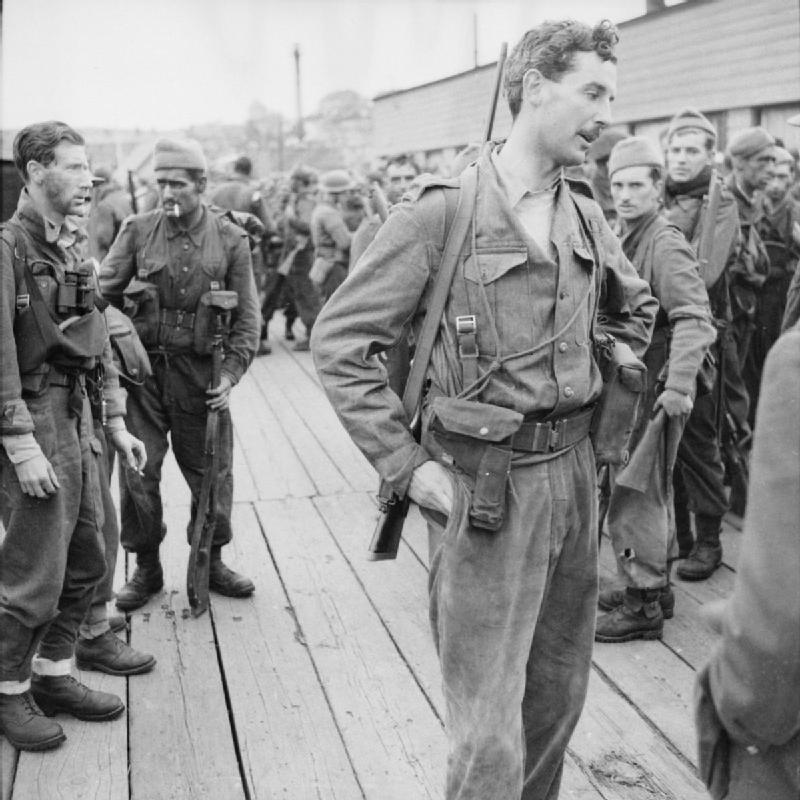
Lord Lovat


Something reminded me of Lord Lovat today. I had seen a History Channel documentary when I was working away from home and came away with a mistaken impression of Lord Lovat's role in the Normandy invasion. I had thought that he had jumped into Normandy, but he actually went ashore at Sword Beach. He did lead part of his brigade, the 1st Special Service Brigade, to Pegasus Bridge to reach the airborne troops of the 6th Airborne Division who had gone in behind the beach in darkness. I can see that he was a charismatic leader of men in combat. I had not realized that his name was Simon Fraser although I had remembered that he was a Scot. This is the Wikipedia image of Lord Lovat in 1942 at Newhaven after Dieppe. Note that Lord Lovat was a 31-year old Lieutenant-Colonel in this photograph and was a 32-year old Brigadier at Normandy. By the wawy, he was known for carrying a Winchester rifle as his personal weapon in battle. The Wikipedia page has more about his life.

Saturday, February 07, 2009

The 150th Infantry Brigade late on 28 May 1942

The 150th Infantry Brigade commander, Brigadier C.W. Haydon, knew by late on 28 May 1942 that he was in trouble. He redeployed to defend in all directions, as an attach from the East, previously his rear, seemed very likely. Early on 29 May, he was joined by the HQ of 1st Army Tank Brigade with the 44th RTR and a squadron of 42nd RTR with 30 infantry tanks. The only bright spot for the British was that General Cruewell had to make a forced landing and was captured. He had been one of the key Axis commanders and his judgment and skill would be missed. This is based on the account in Vol.III of the Official History.

Tuesday, February 03, 2009

Action in the air over the Gazala Battle by 28 May 1942

For some reason, the British only attacked Axis transport for most of the time. Only by late 28 May 1942 did Bostons from No.12 Squadron SAAF hit Commonwealth Keep. This place remained in Axis hands, despite an attempt to retake it. Other Bostons hit the harbour at Derna, where a report had placed an Italian destroyer. Axis fighters and divebombers were very active over the battlefield. They mostly operated in a hit-or-miss fashion, because they had no information about the situation on the ground, which remained very fluid. In three days, the British lost 16 aircraft, while the Germans lost 10 and the Italians lost 7 aircraft. This is based on the account in Vol.III of the Official History.

Saturday, January 31, 2009

A critical fight on 29 May 1942

As the Axis mechanized forces closed on Knightsbridge on 29 May 1942, they were attacked by the 2nd Armoured Brigade. The brigade was locked in combat with the two German panzer divisions and the Italian Ariete Division. Two regiments from the 22nd Armoured Brigade joined the battle. A sandstorm prevented the 4th Armoured Brigade from reinforcing the British armour. The battle lasted through the day, but the German forces were now concentrated, unlike the British. The 90th Light Division had arrived to complete the German concentration. One casualty occurred when General von Vaerst was wounded. He commanded the 15th Panzer Division. Being a general serving with Rommel was a dangerous occupation. This is based on the account in Vol.III of the Official History.

Tuesday, January 27, 2009

Rommel's plan for 29 May 1942

Rommel saw that his forces were scattered across the desert and were desperately in need of supplies. The long route around Bir Hacheim in the south was vulnerable to attack. Rommel's plans were to concentrate his forces, to resupply them immediately, and to open a new supply corridor through the minefields. A corridor in the vicinity of the Trigh Cappuzo would be ideal. Colonel Westphal, as a good staff officer would do, took the initiative with General Cruewell to ask him to penetrate the minefields through 13th Corps in the North. He had the Italian Sabratha Division attack the South Africans, although they were repulsed. Simultaneously, Rommel personally led a supply convoy around the south to the Afrika Korps. This is based on the account in Vol.III of the Official History.

Thursday, January 22, 2009

At the end of 28 May 1942

Gemeral Ritchie was more satisfied with his situation at the end of the day on 28 May 1942 than was justified. The one dangerous situation was that the Italian divisions Trieste and Pavia were penetrating unprotected minefields "near the Trigh Capuzzo and Trigh el Abd". The British still possessed 240 running cruisers and 90 infantry tanks. They expected replacement tanks to arrive the next day in the form of 40 cruiser tanks and 30 infantry tanks. General Auchinleck thought that his forces were not feeling the necessary urgency, and was concerned. The British were feeling cocky, however, as they captured a copy of Rommel's plans. They figured that they had dealt the Axis forces a good blow. This is based on the account in Vol.III of the Official History.

Sunday, January 18, 2009

The air forces on 28 May 1942 at Gazala

The British air commander, Air Vice-Marshal Conyngham, was committed to provide low-level attacks on Axis forces in the battle. Fighter-bombers attacked targets near El Adem and Bir Hacheim on 28 May 1942. Fighter-bombers and day bombers probably hit the 15th Panzer Division, although in conditions of poor visibility. The British pretty much had free-rein over the battlefield on this day, as the Axis air forces were probably uncertain over their troops' positions in the mobile battle. This is based on the account in Vol.III of the Official History.

Wednesday, January 14, 2009

The next day: 28 May 1942

The 21st Panzer Division and the Ariete Division were able to move on 28 May 1942. The 21st Panzer Division penetrated very far north and took "Commonwealth Keep". The 1st Armoured Division commander, General Lumsden, had wanted to attack the 21st Panzer Division with his two armoured brigades, but the 22nd Armoured Brigade stayed with the 15th Panzer Division. The 2nd Armoured Brigade did attack the Ariete Division west of Knightsbridge. The 1st Army Tank Brigade also hit the Ariete Division from the northwest at the same time. The 4th Armoured Brigade hit the 90th Light Division and pushed it to the south and west. This is based on the account in Vol.III of the Official History.

Sunday, January 11, 2009

The Axis forces at the end of 27 May 1942

The Axis forces had penetrated deep behind the British front at Gazala by dusk on 27 May 1942. The 15th and 21st Panzer Division were just west of El Adem, but had lost one third of their tanks. The 15th Panzer Division was short of fuel and ammunition. The 90th Light Division was somewhat farther east, south of El Adem. The Italian Ariete Armoured Division had attacked Bir Hacheim, but was repulsed. The Trieste Motorized Division had turned north too quickly and was trapped in minefields west of the Gazala line. The DAK headquarters was trapped, without support, just south of Bir Harmat. Rommel's response to the situation was a planned advance with the remaining mobile force, the 21st Panzer Division. This is based on the account in Vol.III of the Official History.

Amazon Ad